
Which First Aid Course Do You Need?
A plain map of the options — EFAW, FAW, requalification, paediatric and mental health first aid — with the one sentence that describes your situation.
Enquire about this training
Tell us what you need and we will come back with dates and a price.
Or call 0845 838 4643
Quick answer
Pick by setting, not by name. Workplace: Emergency First Aid at Work (1 day, lower hazard) or First Aid at Work (3 days, higher hazard). Childcare, nurseries and schools: Paediatric First Aid. Renewing an existing FAW certificate: FAW Requalification (2 days) — booked before it expires. Mental health: Mental Health First Aid, which is separate from the first aid regulations. Then choose the format: open courses for one or two people, group courses at your premises for four or more.
The names are not self-explanatory, and providers do not always help. This page maps the whole range in one place, so you can find the one sentence that describes your situation and stop reading.
Every course, compared
| Course | Length | Who it is for | Valid | Renewal |
|---|---|---|---|---|
| Emergency First Aid at Work (EFAW) | 1 day | Lower-hazard workplaces; back-up first aiders anywhere | 3 years | Repeat the course |
| First Aid at Work (FAW) | 3 days | Higher-hazard workplaces; lead first aiders | 3 years | 2-day requalification |
| FAW Requalification | 2 days | Renewing a current FAW certificate | 3 years | — |
| Paediatric First Aid | 2 days | Nurseries, childminders, early years, school staff | 3 years | Repeat the course |
| Emergency Paediatric First Aid | 1 day | Support staff in childcare settings | 3 years | Repeat the course |
| Mental Health First Aid | Varies | Workplace wellbeing; not a legal requirement | Set by awarding body | Per awarding body |
Find your situation
“We’re an office / shop / small business”
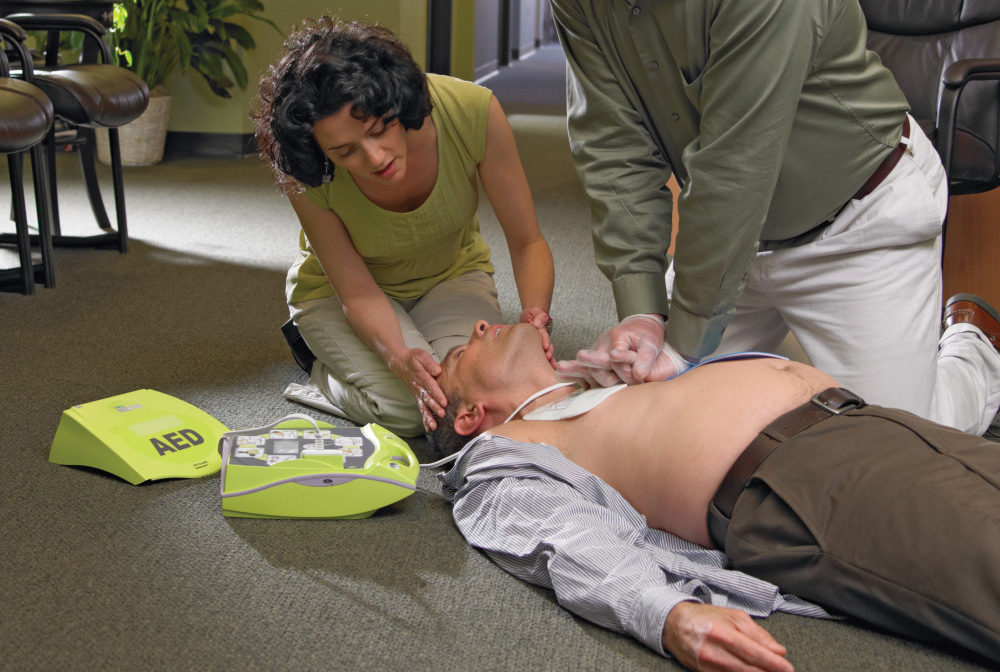
Emergency First Aid at Work (1 day). Covers the things that kill quickly — unresponsive casualty, CPR and defibrillator, choking, bleeding, shock, seizures — and produces a qualified first aider for three years.
“We’re a factory / warehouse / site / workshop”
First Aid at Work (3 days). Everything in EFAW plus fractures, spinal and head injuries, chest injuries, severe bleeding, heart attack, stroke, asthma, diabetes, epilepsy, anaphylaxis, poisoning and eye injuries — with the scenario practice that makes it usable under pressure.
The EFAW-or-FAW decision in detail, with a full syllabus comparison: 1 day or 3 days?
“Our first aider’s certificate is running out”
FAW Requalification (2 days) for FAW, booked before the expiry date. EFAW is renewed by repeating the one-day course. Once a certificate has lapsed the shorter route may no longer be open — see how long does a first aid certificate last?
“We work with children”
Paediatric First Aid. Children are not small adults: the choking technique differs, the CPR ratios differ, and the conditions you are looking for differ. Early years settings in England also have their own requirements under the Department for Education’s EYFS statutory framework, which is what you should check rather than the workplace regulations.
“We want to support staff mental health”
Mental Health First Aid. Worth being clear: this is not required by the Health and Safety (First-Aid) Regulations 1981, and no UK law requires a mental health first aider. What is a legal duty is assessing and managing the risk of work-related stress. See is mental health first aid a legal requirement?
“I just want to learn first aid for myself”
An open EFAW place is usually the right answer. It is a recognised qualification rather than an informal session, it takes a day, and it is as useful at home as at work — see five good reasons to train in first aid.
“We’re a care home / supported living service”
Usually FAW, because of the resident profile rather than the building. Choking, falls, seizures and medical emergencies are all more likely where you support older adults or people with complex needs, and the three-day course covers the medical conditions the one-day course does not.
“We’re a sports club, gym or leisure venue”
At least EFAW, and seriously consider an AED. See sports injury first aid.
Then pick the format
| Format | Best for | How it’s priced | Where |
|---|---|---|---|
| Open course | One to three people | Per person | Our training venues |
| Group / company course | Four or more, or a whole team | Per course, up to 12 people | Your premises |
| Online | Awareness-level topics and theory | Per person | Anywhere |
Group courses are delivered at your own premises, so there is no travel time and the scenarios can use your actual workplace, equipment and layout. For a team, that is normally both cheaper and more useful.
One limitation to be aware of: practical qualifications cannot be completed entirely online. EFAW and FAW involve practical assessment, because you cannot assess someone’s chest compressions through a screen. Online has a real place for awareness-level training and theory, but not as a substitute for the hands-on part.
Everything we currently run
Deals
First Aid at Work Courses
 Emergency First Aid at Work Group Course
£495.00 Excluding Vat
View course →
Emergency First Aid at Work Group Course
£495.00 Excluding Vat
View course →
 Emergency First Aid Open Course
£85.00 Excluding Vat
View course →
Emergency First Aid Open Course
£85.00 Excluding Vat
View course →
 First Aid at Work Group Course
Price range: £945.00 through £1,145.00 Excluding Vat
View course →
First Aid at Work Group Course
Price range: £945.00 through £1,145.00 Excluding Vat
View course →
 First Aid at Work Open Course
£165.00 Excluding Vat
View course →
First Aid at Work ReQual Open Course
£95.00 Excluding Vat
View course →
First Aid at Work Open Course
£165.00 Excluding Vat
View course →
First Aid at Work ReQual Open Course
£95.00 Excluding Vat
View course →
 Paediatric First Aid Group Course
Price range: £650.00 through £750.00 Excluding Vat
View course →
Paediatric First Aid Group Course
Price range: £650.00 through £750.00 Excluding Vat
View course →
 Paediatric First Aid Open Course
£105.00 Excluding Vat
View course →
Paediatric First Aid Open Course
£105.00 Excluding Vat
View course →
Also available: Mental Health First Aid, health and safety and food safety courses.
How many people should we train?
There is no legal ratio — HSE is explicit that there are no hard and fast rules on numbers. What decides it is your first aid needs assessment, and in practice, whether you still have cover when someone is on leave or off sick. The full method is in how many first aiders does my workplace need?
How to choose a provider
HSE stopped approving first aid training providers in October 2013, so checking one is now the employer’s own job. The short version: ask which awarding organisation is behind the certificate, who the individual trainer will be, what the group size and equipment will be, and what happens if someone cannot attend. The longer version, with HSE’s own guidance: how to choose a first aid training provider.
Frequently asked questions
For a lower-hazard workplace, Emergency First Aid at Work (one day). For a higher-hazard workplace or a lead first aider, First Aid at Work (three days). For childcare, Paediatric First Aid. To renew a current FAW certificate, the two-day FAW Requalification. Your first aid needs assessment should decide which is appropriate.Which first aid course should I do?
Emergency First Aid at Work, at one day. It produces a workplace first aid qualification valid for three years, covering CPR and defibrillator use, choking, bleeding, shock, seizures and the unresponsive casualty.What is the shortest first aid course that gives a qualification?
Yes, substantially. Techniques for infants and children differ from adults — including the choking sequence and CPR — and the conditions covered are different. Childcare settings need Paediatric First Aid, not EFAW or FAW.Is Paediatric First Aid different from First Aid at Work?
Online courses suit awareness-level topics and theory. Workplace qualifications like EFAW and FAW involve practical assessment, which is why they are delivered in person — you cannot assess someone’s chest compressions through a screen.Can first aid training be done online?
It depends on the course and the format. Open courses are priced per person; group courses are priced per course for up to 12 people, which is why groups of four or more are usually cheaper trained together. Current prices are shown against each course above.How much does a first aid course cost?
Often, yes. A common pattern is FAW for one or two lead first aiders, EFAW for the wider group to maintain cover across shifts and absence, and Paediatric First Aid where there is an on-site nursery or childcare provision.Do we need a mix of course types?
Usually First Aid at Work, because the resident profile makes medical emergencies, choking, falls and seizures more likely — and those are covered on the three-day course rather than the one-day one. Choking training in particular is worth prioritising where residents have swallowing difficulties.What course does a care home need?
Three years for EFAW, FAW and Paediatric First Aid. Mental Health First Aid certification periods are set by the awarding body, because MHFA sits outside the first aid regulations.How long are the certificates valid?
Yes, and plenty do — for example FAW for the workplace plus Paediatric First Aid for an on-site nursery. Each has its own three-year validity and its own renewal.Can one person hold more than one first aid qualification?
Tell us your situation
Describe your workplace and how many people need training, and we will tell you which course fits — and if a shorter or cheaper one would do, we will say so. Call 0845 838 4643 or use the enquiry form on this page.
Book this training for your team
On-site anywhere in the UK, open courses, or online — accredited and delivered by experienced trainers.