
10 Things You’ll Know After an Emergency First Aid at Work Course
What the day actually involves, what you will be able to do afterwards, and what the one-day course does not cover. Written to forward to whoever is attending.
Enquire about this training
Tell us what you need and we will come back with dates and a price.
Or call 0845 838 4643
Quick answer
After a one-day Emergency First Aid at Work course you will be able to: assess an incident safely, check a casualty’s response and breathing, put an unresponsive but breathing casualty into the recovery position, give CPR and use a defibrillator, treat a choking casualty, control bleeding, recognise and treat shock, help someone having a seizure, manage minor injuries and burns, and know what belongs in a first aid kit and why. You will be a qualified first aider for three years.
If you are the person booking the course, this is the list to forward to whoever is attending. Most people arrive with no idea what the day involves and a quiet dread of being made to perform in front of strangers. It is not like that.
What you will be able to do afterwards
| # | Skill | What it actually means |
|---|---|---|
| 1 | Approach safely | Check for danger and protect yourself first. A second casualty helps nobody |
| 2 | Assess a casualty | A repeatable sequence — response, airway, breathing — so you are not improvising |
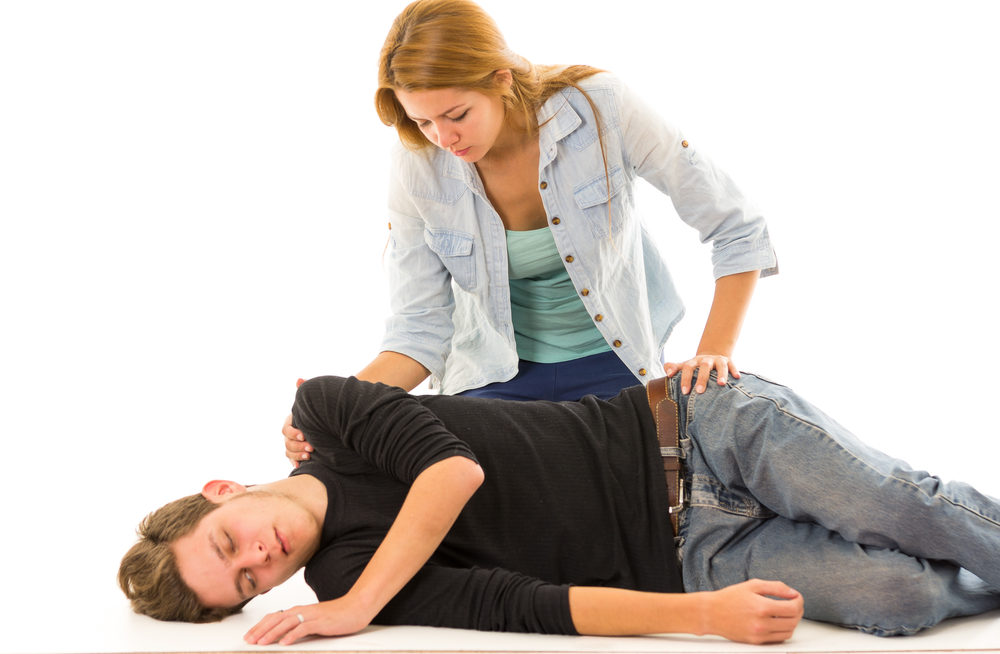
| 3 | Recovery position | For someone unresponsive but breathing. Moving them without hurting them or yourself |
| 4 | CPR | 100–120 per minute, 5–6 cm deep, 30:2 with rescue breaths |
| 5 | Defibrillator (AED) | Handling one before the day you need one — the entire point |
| 6 | Choking | Coughing, then up to 5 back blows and up to 5 abdominal thrusts |
| 7 | Bleeding | Firm direct pressure; adding a layer rather than removing a soaked one |
| 8 | Shock | The circulatory kind, which kills and is easy to miss after another injury |
| 9 | Seizures | Mostly what not to do — protect the head, clear the space, time it |
| 10 | Minor injuries and the kit | Burns (20 minutes under water), cuts, grazes, and what should be in the box |
The ten, in a bit more detail
1. Approaching safely. The first thing taught, and the one people skip in real life. Check for danger, protect yourself, then help.
2. Assessing quickly. Under pressure, people freeze because they do not know what order to do things in. The sequence solves that.
3. The recovery position. Harder than it looks and much easier once you have done it. You will practise moving a real person without straining your back.
4. CPR. The core skill. Almost everyone is too gentle on their first attempt, which is exactly why you practise on a manikin first. You will also find out how tiring it is — effective compressions are exhausting within two minutes.
5. The defibrillator. An AED talks you through it and will not shock anyone who does not need it. Most people are surprised how simple it is, and that surprise is the point: the barrier has never been the device, it is a bystander who does not know it is safe to pick up.
6. Choking. You will practise the technique, including how firmly a back blow actually has to land.
7. Bleeding. Firm direct pressure, dressings, and when bleeding stops being a first aid problem and becomes a 999 call.
8. Shock. Not the emotional kind — the circulatory kind, which can kill and often appears after another injury has taken everyone’s attention.
9. Seizures. Do not restrain them, do not put anything in their mouth. Protect their head, clear the space, time it, and know when it becomes an emergency.
10. Everyday injuries and the kit. Including the twenty-minute cooling rule for burns, which most people get wrong. Plus what a first aid kit should contain and how to spot that yours has quietly run down.
What the day is actually like
| Question | Answer |
|---|---|
| Is it a lecture? | No. You will be on the floor with a manikin within the first couple of hours |
| Is there a written exam? | No. Assessment is practical and continuous — the trainer watches you do each skill |
| How many people? | Twelve maximum, so nobody spends the day watching |
| Do we practise on each other? | No. CPR and choking are practised on manikins; the AED is a training unit |
| What should I wear? | Comfortable clothes you can kneel and move in; flat shoes |
| What if I have a bad back? | Tell us when you book — adjustments are normal |
| Will I be put on the spot? | You will be asked to demonstrate skills, but the trainer’s job is to get you there, not to catch you out |
| Do I get a certificate? | Yes — a workplace first aid qualification valid for three years |
Things worth knowing beforehand
- Ask anything. The questions people are embarrassed to ask are almost always the ones everyone else wanted answered.
- Tell us in advance about anything that affects kneeling or physical exertion — a back or knee problem, pregnancy, limited mobility, a recent operation.
- Tell us about any learning need — materials and delivery can be adjusted.
- You are allowed to find it uncomfortable. Some people have personal experience of an emergency, and this can bring it back. Say so, and step out if you need to.
And what it does not cover
Being straight about this saves disappointment. The one-day course does not cover:
- Fractures, dislocations, head and spinal injuries
- Heart attack and stroke
- Asthma, diabetes and epilepsy in depth
- Anaphylaxis
- Poisoning and eye injuries
- Extended scenario practice and managing an incident with other helpers
Those are on the three-day First Aid at Work course. Children and infants are covered by Paediatric First Aid, because the techniques differ. See 1 day or 3 days? to work out which one your workplace needs.
Afterwards
Your certificate is valid for three years, and EFAW is renewed by repeating the one-day course before it expires. HSE also strongly recommends annual refresher training in between — not a legal requirement, but a sensible one, because these are skills that fade. See how long does a first aid certificate last?
Book a course
Deals
First Aid at Work Courses
 Emergency First Aid at Work Group Course
£495.00 Excluding Vat
View course →
 Emergency First Aid Open Course
£85.00 Excluding Vat
View course →
 First Aid at Work Group Course
Price range: £945.00 through £1,145.00 Excluding Vat
View course →
 First Aid at Work Open Course
£185.00 Excluding Vat
View course →
First Aid at Work ReQual Open Course
£95.00 Excluding Vat
View course →
 Paediatric First Aid Group Course
Price range: £650.00 through £750.00 Excluding Vat
View course →
 Paediatric First Aid Open Course
£105.00 Excluding Vat
View course →
Frequently asked questions
Not a written one. Assessment on Emergency First Aid at Work is practical and continuous — the trainer observes you performing each skill during the day.Is there an exam on a first aid course?
Comfortable clothes you can kneel and move in. CPR is practised on the floor, so trousers are easier than a skirt and flat shoes are easier than heels.What should I wear to a first aid course?
No. CPR and choking techniques are practised on manikins, and defibrillator use on a training unit. You will never have compressions or thrusts performed on you.Do you practise CPR on other people?
Yes. On successful completion of Emergency First Aid at Work you are a qualified workplace first aider, with a certificate valid for three years.Am I a qualified first aider after one day?
Tell us when you book. CPR is physically demanding and practised at floor level, but adjustments can usually be made so you can complete the practical assessment.What if I have a bad back or cannot kneel?
No. Techniques for infants and children differ from adults, and childcare settings need Paediatric First Aid rather than EFAW or FAW.Does the one-day course cover children?
It is unusual, because assessment is continuous and the trainer works with you through the day rather than testing you at the end. Ask your provider in advance what their re-assessment arrangements are.What happens if I do not pass?
Three years. EFAW is renewed by repeating the one-day course before the certificate expires.How long does the certificate last?
Rescue breaths are practised on a manikin using a face shield or a manikin with replaceable parts, never on another person. If you would prefer not to, compression-only CPR is taught as well and is a valid approach in a real emergency.Will I have to give mouth-to-mouth on the course?
Questions before you book?
Call 0845 838 4643 or use the enquiry form on this page.
That is the one-day course. Whether it is the right one for your workplace — and how it differs from the three-day version — is set out in First Aid at Work: 1 day or 3 days? and in workplace first aid requirements. Both sit in our first aid at work course range.
Book this training for your team
At your own premises across Greater Manchester and the North West, open course places in Bolton, or online.